
SAC Rate Explained: What It Is and How to Improve It
If you've ever surfaced with way less air than your buddy despite diving the same profile, SAC rate is the number that explains why. It's the single most useful metric in recreational diving for predicting how long your tank will last, and unlike "I'm just a heavy breather," it's something you can track and improve.
What SAC Rate Is
SAC stands for Surface Air Consumption. It's the rate at which you breathe air, normalized to the surface (1 atmosphere), expressed in liters per minute or PSI/bar per minute depending on where you learned to dive.
The normalization matters. You breathe more gas per minute at 30m than you do at 10m, simply because the gas is more compressed and denser at depth. SAC rate strips out that depth effect so you can compare your breathing efficiency across completely different dives, whether it's a shallow reef at 12m or a wreck at 30m. The underlying formula comes from standard dive-team reference material, including NOAA's Diving Medical Technician formula set and Divers Alert Network's own guidance for recreational divers.[1][2]
The formula:
SAC = (Gas used ÷ Dive time) ÷ Average depth in atmospheres
Where "average depth in atmospheres" is (average depth in meters ÷ 10) + 1. So a dive with an average depth of 20m is 3 atmospheres.
You don't need to calculate this by hand. Any dive computer with a pressure sensor logs your tank pressure throughout the dive, and an app like Currents (or your computer's own software) does the math automatically once you have a start pressure, end pressure, dive time, and average depth.
What Counts as a "Normal" SAC Rate
These ranges are the ones most commonly cited across dive training resources, agency materials, and SAC calculators for recreational diving on a standard aluminum 80 cu ft (11.1L) tank. They aren't the output of one single formal study, they're a widely-used rule of thumb, so treat them as a compass rather than a target:
Your first few logged dives will almost always show a higher SAC rate than your twentieth. That's not a fitness problem, it's a comfort and technique problem, and it resolves with experience far more than with cardio training.
What Moves the Number
DAN's own guidance on estimating air consumption lists current, exertion level, drift versus active swimming, equipment streamlining, buoyancy and trim, and equipment leaks as the primary variables divers can control.[2] In practice, a handful of these matter far more than the rest:
Weighting and trim. Overweighted divers work harder to stay off the bottom and often over-kick to compensate for bad trim, both of which burn more gas. A proper weight check at the start of every trip (and adjusting for a new wetsuit, new tank, or saltwater vs freshwater) is the highest-leverage fix most divers skip.
Breathing pattern. Slow, deep breaths from the diaphragm use less gas than shallow, rapid breathing from the chest, even at the same total minute volume. Anxious divers tend to breathe shallow and fast without realizing it.
Exertion and current. Fighting a current, swimming against a group's pace, or working hard with a camera rig all spike your consumption. If you want an apples-to-apples SAC rate, compare relaxed drift dives to relaxed drift dives, not a current-heavy wreck dive to a calm reef.
Cold and stress. Shivering burns gas. So does genuine anxiety, task-loading (fumbling with a new camera or reel), and unfamiliar equipment. SAC rate is as much a measure of comfort as it is of lung efficiency.
Depth itself, indirectly. Deeper dives mean denser breathing gas, which measurably increases the physical work of breathing even if your minute ventilation in liters stays the same. Research on gas density by Anthony and Mitchell, presented at the 2015 NPS/NOAA/DAN/AAUS rebreather workshop, found that both open-circuit and rebreather divers showed a sharply increased risk of dangerous CO2 retention once respired gas density reached around 6.0 g/L, roughly 4-5 times the density of air at the surface.[3] That research is now the basis for the British Sub-Aqua Club's recommended diving gas density limits (an ideal target of 5.2 g/L, an absolute ceiling of 6.2 g/L).[4] The practical takeaway for recreational divers: don't be surprised if your calculated SAC rate creeps up on deep dives even when you feel perfectly calm, and treat unusually labored breathing at depth as a signal to ascend, not just push through.
How to Improve It
- Get your weighting right first. Everything else is secondary to not fighting buoyancy the entire dive.
- Slow down. Physically moving slower reduces exertion more than almost any other single change.
- Dial in trim. A horizontal, streamlined position reduces drag and the kicking effort needed to move through the water.
- Dive more. Comfort under water is the biggest lever there is, and it only comes from time logged. This is the one that can't be shortcut.
- Track it. You can't improve a number you're not measuring. Logging SAC rate on every dive (not just the good ones) is what turns "I think I'm getting better" into a trend line you can see.
Tracking SAC Rate Automatically
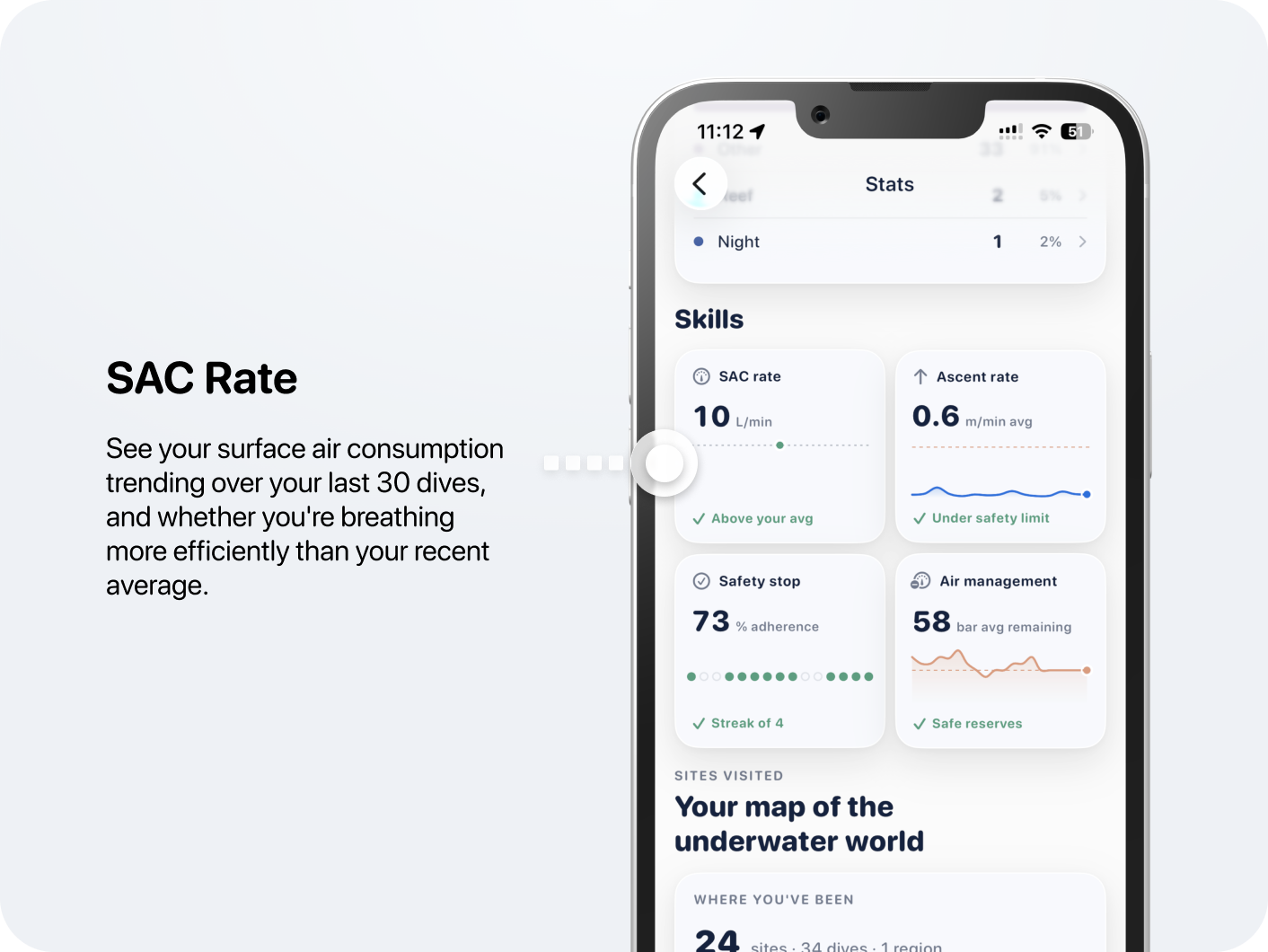
This is the kind of number that's tedious to calculate by hand and easy to track automatically once your dive computer is syncing to a logbook app. Currents Pro pulls your tank pressure and depth data straight from your dive computer, calculates SAC rate for every dive automatically, and shows it as a trend over your last 30 days, six months, or full diving history, so you can see whether that focus on trim last trip made any difference.
If you're shopping for a computer that reports tank pressure (a requirement for automatic SAC tracking), check my dive computer buying guide for what to look for, and my compatibility list for which models sync directly. For the broader safety picture beyond SAC rate alone, DAN's gas management guidance is worth reading in full.[5]
Sources
- NOAA Diving Program. Diving Medical Technician Reference and Formulas.
- Divers Alert Network. Estimating Your Air Consumption, Alert Diver.
- Anthony, G. & Mitchell, S. "Respiratory Physiology of Rebreather Diving." In: Pollock NW, Sellers SH, Godfrey JM, eds. Rebreathers and Scientific Diving. Proceedings of the NPS/NOAA/DAN/AAUS Workshop, June 16-19, 2015. Durham, NC, 2016: 66-79.
- British Sub-Aqua Club. Recommended Diving Gas Mixtures for Open Circuit Diving.
- Divers Alert Network. Lessons in Gas Management, Alert Diver.